
By Dr. Julie Marchiol
Peptides have become one of the most talked about topics in health and performance medicine. What used to be a quiet conversation among physicians and researchers is now showing up everywhere, from podcasts to social media to everyday conversations in my office.
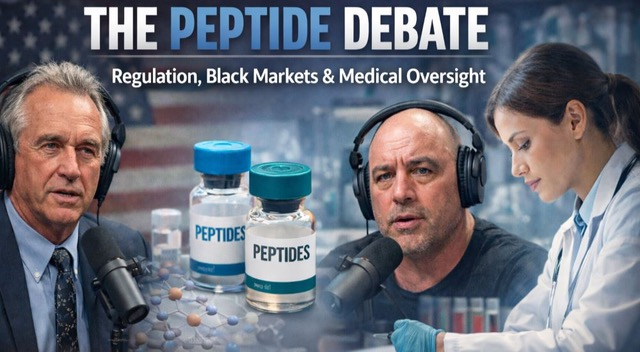
Recently, peptides came back into the spotlight during a conversation between Robert F. Kennedy Jr. and Joe Rogan on The Joe Rogan Experience. Their discussion touched on something many of us in medicine have been thinking about for a while. The tension between innovation, regulation, and access.
It is a complex topic, and it deserves a thoughtful, grounded perspective.
Why Peptides Are Getting So Much Attention
Peptides are not new. They are part of how your body already works.
They are short chains of amino acids that act as messengers. They help guide processes like tissue repair, hormone signaling, immune response, and metabolism.
In my practice, I often explain peptides in a simple way. They help your body do what it is already designed to do, just more efficiently.
That is why so many people are interested in them right now. Patients are looking for ways to support:
- Recovery and healing
- Hormonal balance
- Metabolism and body composition
- Energy and performance
- Healthy aging
As people start looking beyond quick fixes and want to understand what is actually happening in their bodies, peptides naturally become part of that conversation.
The Regulatory Conversation
The recent podcast brought attention to changes in how certain peptides are regulated.
Compounding pharmacies have traditionally played an important role in medicine. They create customized medications when standard options do not fit a patient’s needs.
Recently, some commonly used peptides have been moved into more restricted categories, which has made access through traditional medical channels more difficult.
From a medical perspective, this is where things get complicated.
Regulation is important. It exists to protect patients. But when access becomes limited or confusing, people do not stop looking for solutions.
They just look somewhere else.
The Rise of the Gray Market
When access becomes harder, patients often turn to what is available online.
You will see peptides sold as:
- Research use only
- Not for human consumption
- Veterinary use
These labels allow products to exist in a gray area of regulation.
This is where my concern comes in.
It is not about fear or alarm. It is about clarity and safety.
When someone purchases peptides this way, they often have no real way of knowing:
- What is actually in the product
- Whether the dose is correct
- If the product has been stored or handled properly
- Whether it is even appropriate for their body
That uncertainty matters.
What I See as a Physician
I understand why people are curious about peptides. I see the same interest from my patients every day.
There is real potential here. There is also a lot of noise.
Peptides are not a magic solution. They are one piece of a much larger picture.
In medicine, context matters. Your hormones, your metabolism, your lifestyle, your history. All of it plays a role in how your body responds to any therapy.
When peptides are used appropriately, it should include:
- Proper lab testing
- A clear understanding of your baseline health
- A personalized approach
- Ongoing monitoring and adjustments
This is not about trying the latest trend. It is about supporting your body in a way that actually makes sense for you.
Finding the Right Balance
We are in a moment where healthcare is shifting.
Patients want more information. They want to feel better. They want care that is tailored to them.
That is a positive change.
At the same time, there needs to be a balance between access and safety.
As physicians, we need to stay open to new therapies while still holding a high standard of care. As patients, it is important to work with someone who understands the full picture, not just one piece of it.
The Bottom Line
Peptides are not going away. Interest will continue to grow.
The real question is not whether people will use them. It is how they will access them and who is guiding that process.
My perspective is simple.
If you are going to explore something like peptides, do it in a way that is informed, thoughtful, and supported by real medical insight.
Because the goal is not just to try something new.
The goal is to actually feel better, in a way that is safe and sustainable.
Ready to Do This the Right Way?
If you have been hearing about peptides and wondering if they could help you, the next step is not guessing or ordering something online.
The next step is getting real answers about your body.
In my practice, we start with a full picture. We look at your hormones, your metabolism, your symptoms, and your goals. From there, we build a plan that makes sense for you, not a generic protocol pulled from the internet.
Sometimes peptides are part of that plan. Sometimes they are not.
But either way, you will know exactly why.
If you are ready to feel better and stop piecing things together on your own, I would love to help guide you through it.
Schedule a consultation and let’s figure out what your body actually needs.